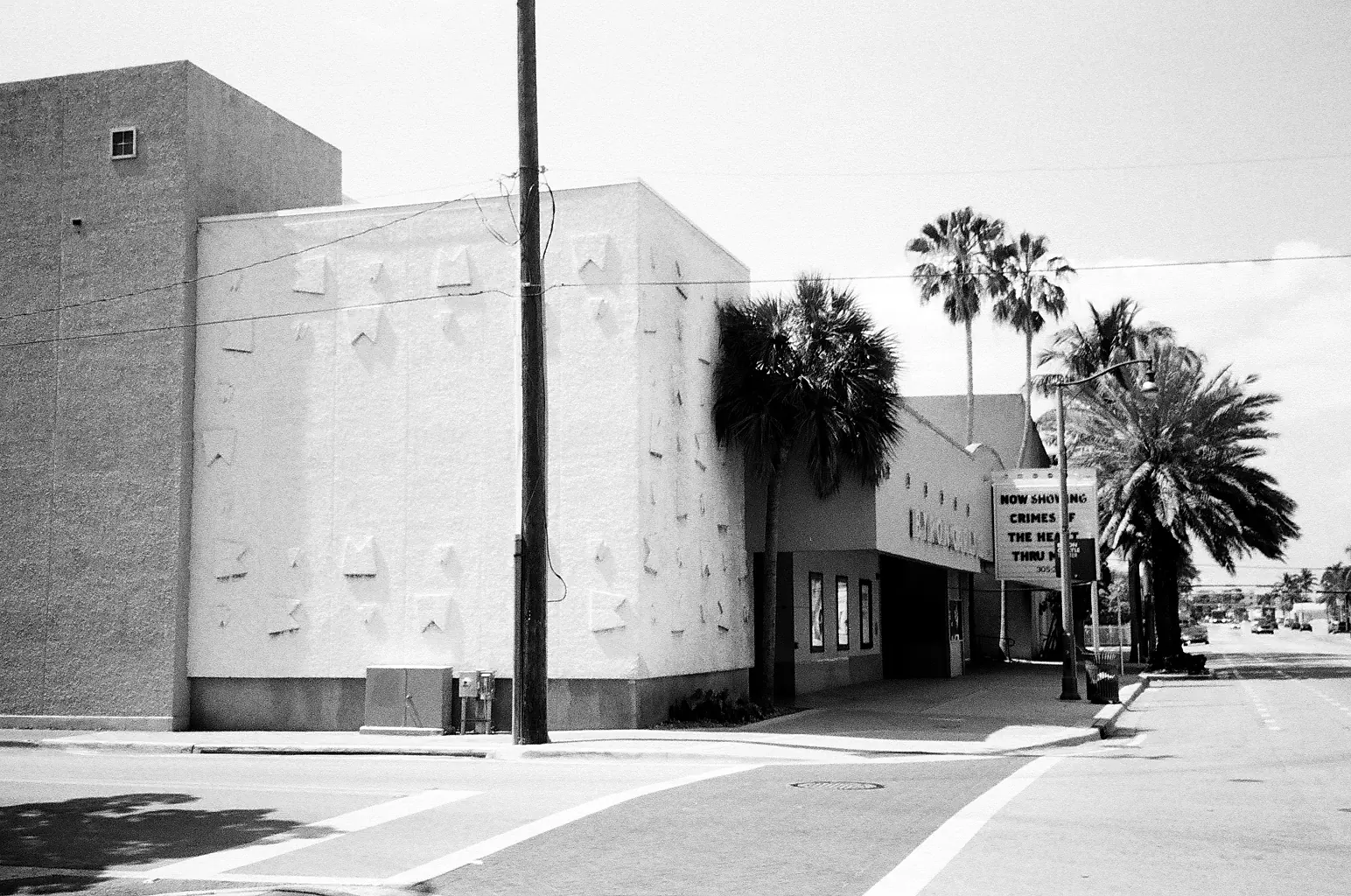
A draft plan would protect the city's $1 million arts grant fund and make the Byron Carlyle Theater North Beach's arts hub. A committee reviews it Nov. 9.
Miami Beach has its first citywide plan for arts and culture in draft. It sets five goals and 48 strategies for the next five years. Among them are reopening the Byron Carlyle Theater as North Beach’s cultural hub and writing the city’s arts grant money into law so it cannot be quietly redirected.
A City Commission committee reviews the draft at 9 a.m. Monday. City Manager Eric Carpenter’s staff asked the Public Safety and Neighborhood Quality of Life Committee to send it to the full commission with a favorable recommendation, according to the committee memo. The plan, called Cultural Currents, is expected to be adopted in December.
The draft was written by the consultant Cultural Planning Group, which the city selected in July 2025. You can read the full 30-page draft on the meeting agenda.
What the plan proposes
The five goals are:
- access to culture in every neighborhood, not only South Beach
- a local, year-round cultural identity beyond Art Basel in December
- public art treated as civic infrastructure
- support for artists and the creative workforce
- stronger and steadier funding for the arts
Some of the most concrete proposals in the draft:
- Byron Carlyle Theater: finish the building program for the North Beach theater, combining a theater or cinema, affordable workspace, community space and artists’ housing. The 2022 bond set aside $30.6 million for it.
- Arts grant money: move the resort tax share that funds city arts grants from a yearly budget choice into the city code. A tougher option is a charter amendment, which would need a vote.
- Art from developers: explore requiring new private projects to contribute public art or a cultural amenity, starting with residential buildings and hotels, with an in-lieu fee option.
- Lincoln Road storefronts: match artists and arts groups with vacant commercial space, starting on Lincoln Road. A storefront pilot drew 325 artist submissions for a handful of spaces.
- Getting there: work on event-night parking and a trolley or shuttle linking North Beach venues to South Beach.
- A separate department: study splitting cultural affairs out of the Tourism and Culture Department into its own department.
- Collins Park: explore branding the Collins Park cluster of museums and venues in South Beach as a cultural district.
Most items are framed as things to “explore” or “evaluate.” The plan does not put a price on them, and the memo lists no fiscal impact.
Where the money goes now
The city spends $13.06 million a year on arts and culture across four funding streams, or $159.23 per resident, the draft says. That is more per person than any peer city it compared, including San Francisco and New York.
The consultant’s concern is the mix. Special events production and promotion take 64% of the total. Grants to arts groups and programming take 14%.
Grants run through the Cultural Arts Council and are paid from the resort tax. They total about $1.025 million a year and have been flat for three budget cycles, the draft says. Smaller “Cultural Presenter” groups get an average of $15,000 to $18,000 each. Fourteen of the 16 larger “Cultural Anchor” institutions have been funded in each of the last five years, with none leaving.
The draft says the arts share of the resort tax is set each year in the budget and is not written into city law, which leaves it “exposed.” It warns that county and state arts cuts, and a possible end to property taxes in Florida, make that riskier.
What residents said
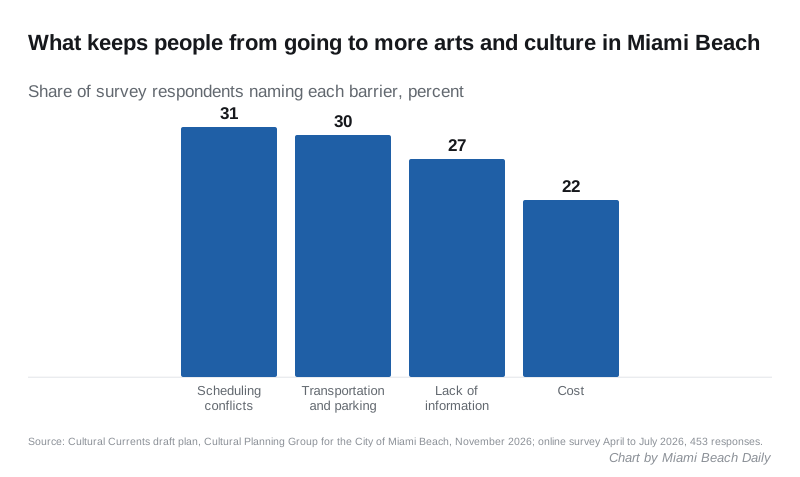
The city surveyed people online from April to July 2026 and got 453 responses, 259 of them from Miami Beach residents. It also held five public events in South Beach, Mid-Beach and North Beach and 29 stakeholder interviews.
- 37% of respondents attend arts or cultural events 12 or more times a year.
- 91% rated the arts very or extremely important to Miami Beach’s identity and reputation.
- North Beach was the only area where residents’ top priority was access across neighborhoods, at 53%. South Beach and Mid-Beach residents put improving and preserving facilities first.
- The Byron Carlyle was named in open-ended answers more than any other facility in the city.
Transportation splits sharply by who is answering. It was the top barrier for 48% of other Miami-Dade residents and of Miami Beach workers who live elsewhere, against 24% of Miami Beach residents.
What it means for you
- Watch or speak Monday: the committee meets at 9 a.m. Monday, Nov. 9, in the Commission Chamber on the third floor of City Hall, 1700 Convention Center Drive. It is also on Zoom, webinar ID 878 3335 2956, or by phone at 888-475-4499. The plan is item 5 on the agenda.
- Next step: if the committee backs it, the plan goes to the full City Commission, with adoption expected in December.
- North Beach: the plan makes the Byron Carlyle the top neighborhood project, but it sets no opening date. Check the city’s meetings and agendas page for when it reaches the commission.
For what is on this month, see our things to do page.
Have your say